Swivel Seat vs Transfer Plate: Which Is Right for You?
When it comes to improving ease of access into a vehicle, two of the most commonly considered solutions are a swivel seat and a transfer plate. While both are designed to support people with reduced mobility, they work in very different ways, and the right choice depends on your level of mobility, vehicle type, and long-term driving or passenger needs.
Or, if you’re researching cars suitable for swivel seats, or wondering what cars can have a swivel seat fitted, this guide will help you decide which solution fits your lifestyle best.
What is a Swivel Seat?
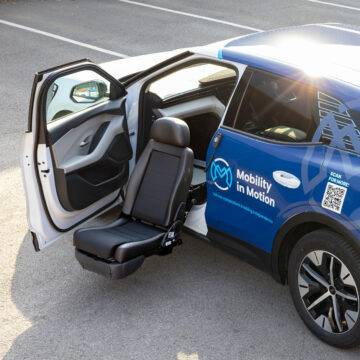
A swivel seat is a vehicle seat system that rotates outward from the car to support easier access. There are also swivel seats that include a lowering and raising function, which is especially important when there is a significant height difference between a wheelchair and the car seat.
For example, where a wheelchair seat may be lower than the vehicle seat, a lowering swivel seat can be utilised to reduce strain during transfer and improve alignment.
Swivel seats are commonly used to:
- Support independent transfers where possible
- Assist users who can partially weight-bear but need controlled movement
- Reduce or eliminate manual handling for carers when independent transfer isn’t possible
- Improve safety and comfort during vehicle entry and exit
They can therefore play a dual role: promoting independence for users, while also being a vital carer-assisted transfer solution for others.
What is a Transfer Plate?
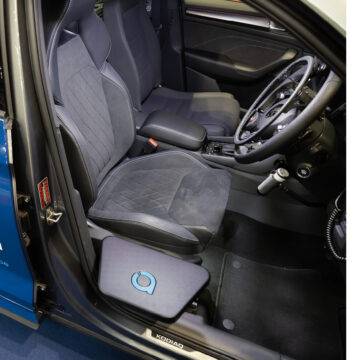
A transfer plate is a fixed mobility aid installed into a vehicle to bridge the gap between a wheelchair and the car seat. It also supports any one who utilises the ‘bottom first’ technique when getting seated.
Unlike portable boards, all of our transfer plates are permanently fixed into one vehicle, ensuring safety, stability and consistent positioning. There are even electric transfer plates that have electronic height adjustment, allowing the transfer surface to be raised or lowered. This is particularly useful when:
- There is a height difference between wheelchair and car seat
- The vehicle seat is significantly higher than the wheelchair
- Transfers into taller vehicles such as SUVs or MPVs are required
This adjustability helps reduce strain and improve safety during independent and assisted transfers.
Transfer plates are typically used when:
- The user can still transfer with support but cannot pivot easily
- A swivel seat is not compatible
- A simpler and cost-effective solution is preferred
Try them out for yourself!
Through our mobility assessments, we will assess your vehicle, mobility equipment, and personal needs to recommend the safest and most practical solution.
Pop your details in our form, and a member of our friendly team will be in touch to arrange an assessment at a convenient date and time for you.
Get in touch to book a mobility assessment
Which is Better for Wheelchair Users: Swivel Seat or Transfer Plate?
There is no single “best” option, the right choice depends on the user’s mobility, strength, and how they transfer in and out of a vehicle. Both swivel seats and transfer plates improve access, but they support different types of movement.
A swivel seat is usually better for users who need controlled rotation to get in and out of a vehicle. Many also include lowering and raising functions, which help bridge height differences between a wheelchair and the car seat. This reduces lifting strain and can support independent transfers, or significantly reduce manual handling for carers when assistance is required.
A transfer plate is better suited to users who can transfer by sliding sideways but need a stable, fixed surface. It provides a secure platform between wheelchair and car seat, helping maintain control during lateral movement. Some systems also offer electronic height adjustment, which is useful when transferring into higher vehicles or when there is a significant seat height difference.
In simple terms:
- Swivel seat = rotation + optional height adjustment + easier positioning
- Transfer plate = stable sideways slide + fixed support + optional height adjustment
The right solution depends on several factors, including:
- Upper body strength and trunk control
- Ability to pivot vs slide
- Level of carer assistance required
- Seat height difference between wheelchair and vehicle
- Door size and internal vehicle space
This is why a professional mobility assessment is essential, to ensure the chosen system is safe, practical, and compatible with both the user and the vehicle.
Both solutions ultimately aim to make vehicle access safer and more manageable, but they achieve it in different ways depending on individual needs.
Swivel Seat vs Transfer Plate: Key Differences
| Feature | Swivel Seat | Transfer Plate |
| How it works | Seat rotates outwards (often lowers/raises too) | Fixed plate supports sideways sliding transfer |
| Independence | Can support independent transfers + support assisted transfers | Typically for independent use |
| Cost | More expensive; starts from £1,652 (includes installation & 3-year warranty) | More affordable; prices start from £595 (includes installation & 3-year warranty) |
| Supportive Accessories | A comprehensive range of accessories can be added based on your individual needs | No additional options or accessories available as not usually required |
Which Should You Choose?
Choosing between a swivel seat vs transfer plate depends on several factors, including:
- Your individual mobility and capabilities
- The type of vehicle you have
- Whether you require an assisted transfer
Because every person’s mobility is different, the best solution is often determined through a professional mobility assessment.
At Mobility in Motion, our specialists will assess your vehicle, and personal needs to recommend the safest and most practical solution.
Commonly Asked Questions
What is the difference between a swivel seat and a transfer plate?
A swivel seat rotates outward from the vehicle (often with lowering/raising functions) to support easier seated transfers, while a transfer plate is a fixed sliding surface that allows a user to move sideways from a wheelchair into the car seat. Swivel seats focus on rotation and positioning, whereas transfer plates focus on lateral transfer support.
Is a transfer plate cheaper than a swivel seat?
Yes, transfer plates are generally more affordable than swivel seats because they are simpler systems with fewer mechanical components. Swivel seats involve powered rotation (and often lowering/raising functions), which increases installation complexity and cost.
Do you need upper body strength to use a transfer plate?
Yes, some upper body strength and trunk control is usually required to use a transfer plate safely, as the user typically needs to slide themselves across the surface.
Can a transfer plate be folded away?
Some designs include a folding feature so once you’re seated in the car you can simply fold it upwards while other designs have a quick release feature which means you can easily remove the plate once you’re seated and store it in the car for the journey.
Which is better for wheelchair users: swivel seat or transfer plate?
Neither is universally “better” as it depends on the individual. A swivel seat is often better for users who want greater independence or reduced carer assistance, especially when seat height adjustment is needed. A transfer plate may be better for users who can slide transfer but do not require a rotating seat mechanism. A mobility assessment is essential to determine the safest option.
Final Verdict: Swivel Seat or Transfer Plate?

Both swivel seats and transfer plates are highly effective mobility solutions, but they serve different needs. Swivel seats focus on rotational access and independence with optional lowering support, while transfer plates provide a stable, fixed transfer platform with optional height adjustment.
Because suitability depends on factors like seat height, door aperture, range of movement, and whether transfers are independent or assisted, the best next step is to book a professional mobility assessment.
Our team will help you confirm:
- Whether a swivel seat or transfer plate is most appropriate
- Vehicle compatibility
- The safest option for independent or assisted transfers
Book your mobility assessment today and let us help you find the safest and most comfortable vehicle access solution.

Driving with adaptations
Car Insurance for Disabled Drivers
Learn how car insurance works for adapted cars. Discover what to declare, common misconceptions and how Adapt & Drive can help.

Accessible travel
Who Can Drive a Motability Car?
One question continues to come up time and again: who can actually drive a Motability car? Here we outline the simple guidance.
Accessible travel
The Best Used Cars for Disability Adaptations (2026 Expert Guide)
Looking for the best used car to adapt for a disability? Discover our top 5 recommendations, expert buying advice, typical prices and compatible vehicle adaptations.