Which Car Is Easiest to Get In and Out Of?
The Best Cars for Easy Access, Wheelchair Transfers and Disabled Passengers
If getting in and out of your car has become uncomfortable or challenging, you’re not alone.
Whether it’s due to arthritis, reduced mobility, disability, recovering from surgery or simply changes that come with age, something as routine as getting into a vehicle can quickly become one of the most difficult parts of the day.
Many people immediately assume they need a completely different car, or can no longer travel at all. But after helping thousands of customers find the right mobility solution, we’ve learned something important:
The easiest car to get in and out of isn’t always about the vehicle itself. More often, it’s the combination of the right vehicle and the right adaptation that makes the biggest difference.
A well-positioned seat, wider door opening and comfortable step-in height can all improve accessibility. Add a professionally fitted swivel seat, transfer plate or person hoist, and a vehicle that once felt difficult to access can become comfortable, safe and confidence building.
Whether you’re:
- Exploring our Adapt & Drive scheme
- Adapting a vehicle you already own
- Choosing your next Motability vehicle
This guide explains what really makes a car easier to access and the adaptations that can transform everyday travel.
Need help choosing the right vehicle or adaptation?
Book an assessment with one of our mobility specialists and we’ll recommend the solution that’s best suited to your mobility, lifestyle and budget
What Actually Makes a Car Easy to Get In and Out Of?
People often search for the easiest car to get in and out of, expecting there to be one perfect make or model. In reality, the answer depends on your mobility needs and how you move.
For example:
- Someone with arthritis may benefit from a higher seating position.
- Someone recovering from a hip replacement may need a seat that swivels.
- A wheelchair user who can transfer independently may need wide-opening doors and a transfer plate.
- Someone requiring assistance may benefit from a person hoist or a Carony wheelchair transfer system.
That’s why our assessments always begin with understanding your mobility needs before recommending a vehicle.
When assessing how accessible a car is, we look at five key factors.
1. Seat Height
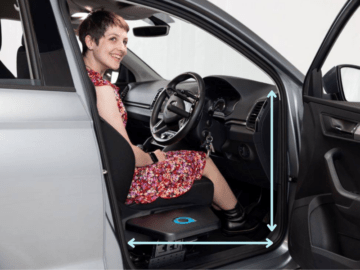
Seat height is one of the biggest factors in how easy a vehicle is to access, but the ideal height depends on how you transfer.
If you are ambulatory, walk independently or use a walking aid, a seat that’s too low can make it harder to sit down and stand up, while a seat that’s too high may require you to climb into the vehicle.
If you’re transferring from a wheelchair, the height of your wheelchair in relation to the vehicle seat is equally important. A closer match in height often allows for a smoother, more comfortable transfer, while larger height differences may require additional effort or the support of adaptations such as a swivel seat, transfer plate or Carony transfer system.
That’s why we assess both your mobility and your transfer method before recommending the most suitable vehicle and adaptations.
2. Door Width and Opening Angle
A wide door opening provides more space to move your legs, position mobility devices and complete transfers safely.
This becomes even more important if you’re considering adaptations such as:
The larger the opening, the easier these systems are to use comfortably.
3. Step-in Height
Many people ask “What car has the lowest step-in height”?
While low vehicles reduce climbing, they’re not always the easiest to access.
The ideal step-in height allows you to sit almost sideways onto the seat without needing to crouch or climb. That’s why many customers find medium-height SUVs strike the best balance between comfort and accessibility.
4. Roof Height
Roof height is often overlooked. If the roofline is too low, you need to duck your head while bending your back and knees simultaneously.
For anyone with limited flexibility, this can quickly become uncomfortable.
Vehicles with a taller roof opening allow you to remain more upright throughout the transfer.
5. Adaptation Compatibility
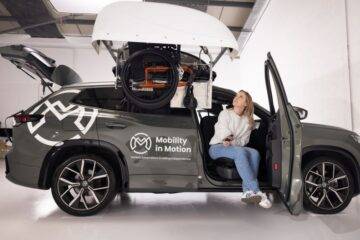
This is perhaps the most important factor, and one that many online buying guides completely overlook.
Even the most comfortable vehicle may not be suitable if it can’t accommodate the adaptation you need.
Before recommending any vehicle, we consider whether it’s compatible with the adaptations you require, such as:
- Swivel seats
- Transfer plates
- Person hoists
- Hand controls
- Steering aids
- Pedal adaptations
- Boot hoists
Planning this from the outset helps ensure your vehicle continues to meet your needs now and into the future.
What Seat Height Is Best for Disabled Drivers and Passengers?
This is one of the questions we hear most often, and the answer isn’t simply “the higher, the better.”
The ideal seat height depends on how you transfer.
- If you walk or use a walking aid, a seat that allows you to place both feet firmly on the ground and stand up without excessive bending is often the most comfortable.
- If you transfer from a wheelchair, the height of your wheelchair seat in relation to the vehicle seat is another important consideration. A similar height can make transfers easier, while greater height differences can often be overcome with adaptations such as a swivel seat, transfer plate or Carony wheelchair transfer system.
Vehicles such as the Nissan X-Trail, Vauxhall Frontera and Kia Sportage are popular choices because their medium seating height suits many customers and they’re compatible with a wide range of adaptations.
Ultimately, the best car isn’t necessarily the one with the highest seat, it’s the one that can be adapted to support safe, comfortable and confident transfers. That’s why every assessment, particularly as part of our Adapt & Drive Scheme, looks at both the vehicle and the adaptations that will work best for your individual needs.
Does Door Width Affect How Easy a Car Is to Access?
Absolutely. Door width can have just as much impact as seat height. A wider door opening gives you more room to:
- position your feet safely
- turn your body
- transfer from a wheelchair
- use walking aids
- operate a swivel seat
- use a transfer plate
It’s one of the first measurements we check during our mobility assessment because it directly affects which adaptations can be fitted and how comfortably they’ll work.
This is also why we don’t simply recommend “the best car”, we recommend the best vehicle and adaptation package for you.
The Right Adaptation Can Make a Bigger Difference Than Simply Changing Your Car
Many people when they start to struggle with transfers automatically think they need a new vehicle.
Sometimes that’s true. But many of our customers discover they can continue enjoying their current car with the addition of a professionally installed adaptation.
Others choose a brand-new adapted vehicle through our Adapt & Drive scheme because it’s already been selected for its accessibility and compatibility with adaptations.
Either way, the goal is the same: making every journey easier, safer and more comfortable. The right adaptation can reduce strain on your joints, improve confidence when travelling and help you maintain your independence for longer.
In the next section, we’ll explore the most popular vehicle adaptations, explain who they’re best suited to, and share how one customer found the perfect combination of vehicle and adaptation through our Adapt & Drive scheme.
Adaptations Transform How You Get In and Out of a Car
When people search for the best car for disabled passenger access or the easiest car to transfer into from a wheelchair, they’re often looking for a vehicle that solves every challenge.
But this is rarely the case, and instead it’s the adaptation that’s as important as the vehicle itself.
We’ve worked with customers who assumed they needed to replace their car, only to discover that a professionally fitted swivel seat or transfer aid made their existing vehicle much easier to access.
Swivel Seats: Reducing Strain
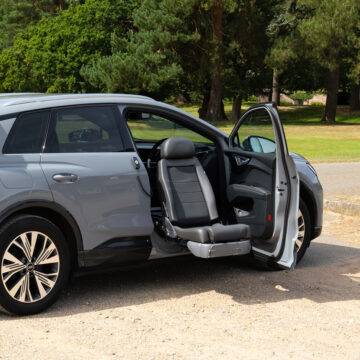
A swivel seat is one of the most effective vehicle adaptations for people who find it difficult to twist, bend or lift their legs into a car.
The seat rotates outwards towards the door, allowing you to sit down first before gently swivelling into the vehicle. Some models also include a lowering and raising function, helping to bridge the height difference between the vehicle seat and a wheelchair. This can make transfers smoother, reduce strain and improve alignment, particularly where the wheelchair seat is lower than the car seat.
Swivel seats can support:
- Independent transfers, where the user can transfer with little or no assistance.
- Assisted transfers, helping carers safely support someone into the vehicle with reduced manual handling.
- Wheelchair users, by improving seat alignment and making sideways transfers easier.
- People with reduced mobility, including those living with arthritis, Parkinson’s disease, multiple sclerosis (MS), hip or knee replacements, or back pain.
If a vehicle is otherwise the right fit for your lifestyle, a swivel seat can often be the adaptation that makes getting in and out comfortable and safe.
Transfer Plates: Bridging the Gap for Easier Transfers
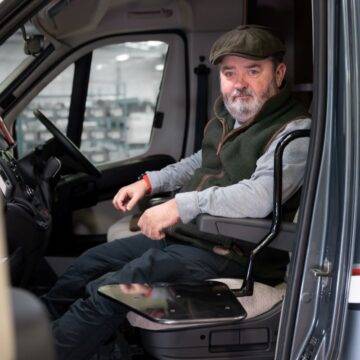
A transfer plate provides a stable surface to help bridge the gap between a wheelchair or standing position and the vehicle seat, making it easier to move safely into the car.
There are even some transfer plates that can also raise or lower to help overcome height differences between a wheelchair and the vehicle seat, creating a smoother and more comfortable transfer.
Transfer plates can be a great solution for people who:
- Transfer from a wheelchair or mobility device
- Can partially weight-bear but need additional support
- Experience pain or difficulty when twisting into the vehicle
- Want a simple, discreet solution to improve confidence when getting seated
Read our in-depth comparison of Swivel Seats vs Transfer Plates: Which Is Right for You?
Person Hoists: Supporting Assisted Transfers
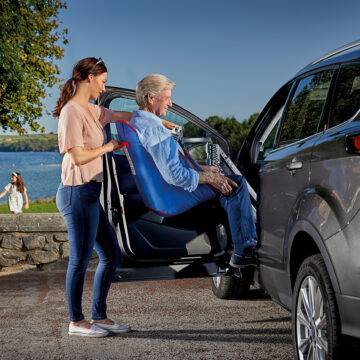
If transferring independently isn’t possible, a person hoist can provide safe, controlled assistance into the vehicle.
Using a specialised sling and a powered arm, the person hoist lifts and moves the individual into the vehicle, significantly reducing the physical effort required by carers.
For many families, a person hoist can make vehicle travel possible when other transfer methods are no longer practical.
Carony Wheelchair Swivel Seats: Staying Seated Throughout the Transfer
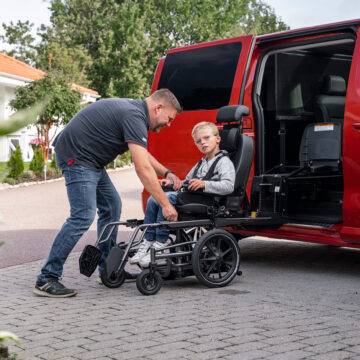
The Carony wheelchair swivel seat offers a different approach to the above adaptations. Rather than transferring between two separate seats, the Carony system allows the seat itself to move between the wheelchair base and the vehicle-mounted swivel base. This means the user remains seated throughout the transfer, helping to reduce physical effort while improving comfort and confidence.
This solution enables the user to move from wheelchair to vehicle without needing to stand, pivot, slide or be lifted.
Explore our comparison guide: Person Hoist vs Carony Swivel Seat: Which Transfer Solution Is Best?
Customer Story: How Elizabeth and Ian Found a Life Changing Solution
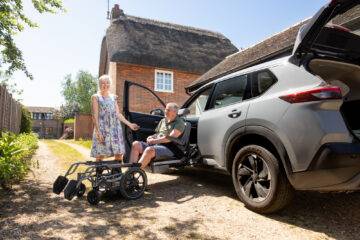
When people think about wheelchair travel, they often assume a Wheelchair Accessible Vehicle (WAV) is the only option.
For Elizabeth and Ian, however, they discovered it wasn’t the right long-term solution.
Although travelling in a WAV meant Ian could remain in his wheelchair, manually pushing him up the ramp and securing the wheelchair with tie-down straps became increasingly physically demanding for Elizabeth. Ian also experienced significant motion sickness travelling in his wheelchair rather than in a standard vehicle seat, making journeys uncomfortable for them both.
They wanted a solution that would make travelling easier, not just getting into the vehicle, but the journey itself. After talking through their needs with our team, they chose a Nissan X-Trail through our Adapt & Drive scheme, fitted with a Carony wheelchair swivel seat.
The Carony system allows Ian to remain seated throughout the transfer, with the seat moving between the wheelchair base and the vehicle. Once inside, he’s seated in a standard passenger seat, improving comfort during the journey.
Reflecting on their experience, Elizabeth said:
“Mobility in Motion was helpful, informative and flexible throughout the process. They understand the varying needs of people living with disability and demonstrate both respect and creative thinking.”
Adapt & Drive Vehicles That Work Well with Adaptations
There’s no single “best” vehicle for everyone. However, these are some of the models available through Adapt & Drive that we regularly recommend because they offer excellent accessibility and work well with a wide range of vehicle adaptations.
Nissan X-Trail
The Nissan X-Trail combines a comfortable seating height with generous interior space, making it a popular choice for customers looking for easier access.
Why we recommend it:
- Comfortable step-in height
- Wide-opening doors
- Spacious cabin
- Excellent compatibility with swivel seats
- Suitable for the Carony wheelchair swivel seat
- Good boot space for mobility equipment
As Elizabeth and Ian discovered, it’s a vehicle that pairs exceptionally well with advanced transfer solutions.
Vauxhall Grandland
The Vauxhall Grandland combines a comfortable seating position with a spacious interior, making it an excellent choice for people looking for easier vehicle access without stepping up to a larger SUV.
It’s particularly well suited to customers choosing:
- Swivel seats
- Transfer plates
- Boot Hoists
- Driving adaptations, including hand controls
Its raised seating height, wide-opening doors and generous cabin space make transfers easier, while its compatibility with a wide range of vehicle adaptations means it can continue to support your mobility needs as they change over time.
Kia Sportage
The Kia Sportage continues to be one of the UK’s most popular family SUVs, and for good reason.
It offers:
- Higher seating position
- Wide door openings
- Comfortable access
- Generous boot capacity
- Excellent adaptation compatibility
Kia EV6
The Kia EV6 proves that electric vehicles can also offer excellent accessibility. Its spacious cabin, flat floor and generous interior make it a popular choice for customers looking to future-proof their mobility without compromising on comfort.
It’s particularly well suited to:
With a comfortable seating position and plenty of cabin space, the EV6 offers an excellent balance of accessibility, practicality and modern electric driving.
Vauxhall Corsa
Not everyone needs, or wants, a larger SUV. The Vauxhall Corsa is a compact, easy-to-drive hatchback that can be adapted to support a wide range of mobility needs.
It’s often a great option for customers who:
- Prefer a smaller vehicle that’s easier to park
- Need driving adaptations such as hand controls
- Are looking for an accessible vehicle without moving to a larger car
Despite its compact size, the Corsa is compatible with a variety of adaptations, making it an excellent choice for drivers who value manoeuvrability as much as accessibility.
Already Own a Car? You May Not Need to Replace It
If you already own a car that otherwise suits your lifestyle and requirements, you can also explore adaptations to make it more accessible for you.
Many of the adaptations already mentioned throughout this guide can also be fitted to a car you already have, or a used car. We speak to many customers who have assumed that adaptations are only possible for brand-new cars, which isn’t the case!
A professional assessment will help determine whether your existing vehicle can be adapted safely and comfortably. For many customers, this is the most cost-effective route to improving accessibility and ensuring they can enjoy more miles out of their well-loved car.
Frequently Asked Questions
What is the easiest car to get in and out of if you have mobility problems?
The easiest car depends on your individual mobility needs. Generally, vehicles with a comfortable seat height, wide-opening doors and good adaptation compatibility provide the easiest access. For many people, the right adaptation, such as a swivel seat or transfer plate, can make an even bigger difference than changing a vehicle.
What car has the lowest step-in height?
Rather than looking for the lowest step-in height, it’s better to choose a vehicle where the seat is positioned at a comfortable height for transferring. Medium-height SUVs often provide the best balance between bending down and climbing up.
What is the best car for a wheelchair user who can transfer?
Many wheelchair users who can transfer independently benefit from vehicles with wide door openings, generous cabin space and compatibility with adaptations such as transfer plates or swivel seats. The Nissan X-Trail is one example of a vehicle that works particularly well with these solutions.
What seat height is best for disabled drivers and passengers?
A seat height that allows your hips to remain close to knee height is often the most comfortable for standing and sitting. However, the ideal height varies depending on your mobility.
Does door width affect how easy a car is to access?
Yes. Wider doors make it easier to transfer, position walking aids, operate a swivel seat and move safely into the vehicle. Door width is one of the key factors we assess when recommending vehicles and adaptations.
Can I fit a swivel seat to my existing car?
In many cases, yes. Compatibility depends on the make and model of your vehicle, its door aperture size vs the height of the user. A professional assessment is the best way to determine what’s possible.
Find the Right Vehicle, and the Right Mobility Solution
Choosing the easiest car to get in and out of isn’t just about comparing makes and models, it’s also about understanding how you move, how you travel and what will help you stay independent.
During your mobility assessment, we’ll take the time to understand your mobility needs, demonstrate suitable adaptations and help you explore the options available, whether that’s a swivel seat, transfer plate, person hoist or the Carony wheelchair swivel seat.
Book an assessment today and let our specialists help you find the vehicle and adaptations that make every journey easier, more comfortable and more enjoyable.

Accessible travel
Making Family Life Easier: Choosing The Right Vehicle For Disabled Families
Whether you’re transporting a wheelchair, or adapting the vehicle for a disabled driver, find out how to choose the right vehicle.

Driving with adaptations
Car Insurance for Disabled Drivers
Learn how car insurance works for adapted cars. Discover what to declare, common misconceptions and how Adapt & Drive can help.
Accessible travel
Who Can Drive a Motability Car?
One question continues to come up time and again: who can actually drive a Motability car? Here we outline the simple guidance.